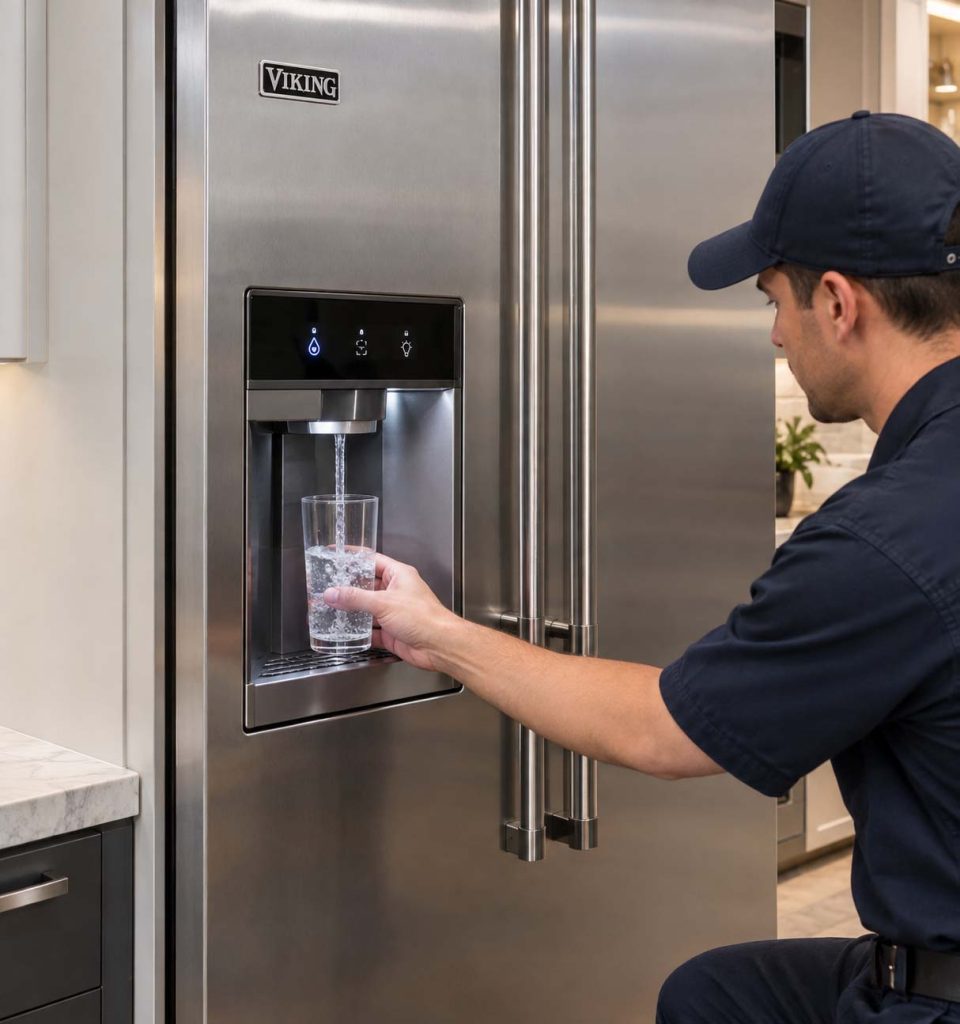

Most Viking refrigerator problems trace to one of six faults. Common causes include dirty condenser coils, a failed evaporator fan, a worn door gasket, a clogged defrost drain, an ice maker supply problem, or sealed-system failure. Start with a power-cycle reset and a coil cleaning, which clear most cooling and noise complaints.
Viking refrigerator troubleshooting starts with the simplest causes and works toward the complex ones. This guide covers every common fault the way a technician triages it, from a warm fridge to a puddle on the floor. You will learn the likely cause of each symptom, the first checks to make, and when a repair stops being a do-it-yourself job. Viking Repair Pro is a Viking-only appliance specialist serving eight markets across Colorado, Nevada, California, Arizona, and Oregon. If the basics do not solve it, you can book a diagnostic visit.
Start here: reset your Viking and check the basics
Before you diagnose a single part, run a reset and a five-point check. A surprising share of Viking faults are settings, airflow, or a power glitch, not a broken component. Unplugging a Viking refrigerator for 1 to 5 minutes resets the control board and clears many minor cooling and display faults.
- Power and breaker: confirm the unit has power and the breaker has not tripped.
- Temperature settings: set the fridge to 37°F and the freezer to 0°F.
- Interior vents: move food away from the rear vents so cold air can circulate.
- Door seal: run the dollar-bill test on the gasket to check for leaks.
- Condenser coils: if they look dusty, clean them, the top fix for weak cooling.
If the fridge still misbehaves after that, match your symptom to the sections below.
Viking refrigerator not cooling
A Viking that runs but will not cool almost always points to airflow or the sealed system. Check in this order: coils, then the evaporator fan, then the temperature sensor, then the compressor. Dirty condenser coils are the single most common cause of gradual cooling loss in a Viking refrigerator.
With the compressor running, put your ear near the freezer panel. If you do not hear the evaporator fan, the motor may have seized or ice may be blocking the blades. A cold freezer paired with a warm fridge usually means that single evaporator fan has failed or a damper is stuck.
If the coils are clean and the fan runs but cooling is still weak, the fault is inside the sealed system. For the full step-by-step, see our guide to a Viking refrigerator not cooling.
Viking refrigerator making strange noises
With a Viking, the location of the noise matters more than the sound itself. Each spot points to a specific, repairable part. A buzzing from the rear base is usually the condenser fan, while grinding behind the freezer panel points to the evaporator fan.
Clicking near the compressor at startup often means a failing start relay, a $20 to $50 part and one of the easier swaps on these units. A steady hum is normal, but a loud or new hum can signal a relay or worn bearing. None of these sounds means the refrigerator is failing.
See what each Viking refrigerator noise means for the full breakdown.
Viking refrigerator leaking water
A puddle under or inside a Viking usually comes from one of four places, and most are inexpensive fixes. A clogged defrost drain is the most common cause of water leaking inside a Viking refrigerator.
- Clogged defrost drain: meltwater backs up and pools on the floor; clear it with warm water from a turkey baster.
- Worn door gasket: humid air enters, condenses, and overwhelms the drain as excess melt.
- Drain pan overflow: often paired with dirty coils, since the pan relies on condenser heat to evaporate water; clean the coils first.
- Loose or cracked water line: on models with an ice maker or dispenser, check every connection at the rear of the unit.
Fix the source quickly to avoid damage to your floor and cabinets.
Viking ice maker and freezer problems
Ice maker and freezer faults on a Viking usually trace to water supply, temperature, or the defrost system. Start with the easy checks before assuming a part has failed. Most Viking ice maker failures come down to a closed water valve, a kinked line, or a filter older than 6 months.
Confirm the water supply valve is fully open, the line is not kinked, and the freezer holds 0°F. If all three check out, the inlet valve or ice maker module may need replacement. For frost buildup or a freezer that will not freeze, suspect the defrost system, a worn gasket, or an overpacked compartment.
For the full diagnostics, see Viking ice maker not making ice and Viking freezer not freezing.
Viking control panel and error codes
An unresponsive Viking control panel is often a power glitch, not a dead board. A blank or frozen Viking display often clears after a short power cycle; if it returns, the board or a sensor needs testing.
Signs of a failing board include a display that will not respond, temperatures that do not change when adjusted, and flickering lights. Power surges are a frequent cause, so a whole-home surge protector is cheap insurance on a built-in Viking. If your Viking shows an F-code, look up that exact code before replacing any part, since each code points to a specific fault.
When to call a Viking technician
Some Viking refrigerator faults are not do-it-yourself jobs, no matter how handy you are. Compressor, refrigerant, and sealed-system repairs on a Viking require EPA-certified handling and specialized tools, so they are never a DIY fix.
Call a professional when the fridge still will not cool after the coils and fan check out, when you smell burning or see refrigerant, or when an error code keeps returning. Built-in Viking models are especially sensitive to disassembly, and opening sealed components without training can cause more damage and void your warranty.
A Viking-only specialist with OEM parts protects an appliance that cost far more than the repair.
Frequently asked questions
How do I reset a Viking refrigerator?
To reset a Viking refrigerator, unplug it or switch off its breaker for 1 to 5 minutes, then restore power. This clears the control board and fixes many minor cooling and display faults. If the same problem returns quickly, the issue is a component rather than a glitch, and it needs a closer look from a technician.
Why is my Viking freezer cold but the refrigerator warm?
A cold freezer with a warm fridge almost always means the evaporator fan has failed or a damper is stuck. Viking uses one evaporator to cool both compartments, so when airflow stops, the freezer holds its cold while the fridge warms. A frost-blocked coil from a failed defrost system can cause the same pattern.
How often should I clean my Viking refrigerator coils?
Clean your Viking refrigerator condenser coils every 6 to 12 months, or every 3 to 6 months if you have pets or a dusty home. Dirty coils are the top cause of weak cooling and make the compressor work harder. The job takes about 15 minutes with a coil brush and a vacuum.
When is a Viking refrigerator problem not a DIY fix?
A Viking refrigerator problem is not a DIY fix when it involves the sealed system, refrigerant, or the compressor. Those repairs require an EPA-certified technician and specialized tools. Built-in Viking models are also sensitive to disassembly, so opening sealed components without training can cause more damage and void your warranty.
Diagnose the fault, don’t guess
Most Viking refrigerator faults start small and have a clear cause, from dusty coils to a clogged drain. Working through the checks above solves the common ones and tells you when a part has actually failed. When the fix points to the sealed system, a control board, or a stubborn leak, the right move is a diagnosis, not a guess. Book a Viking refrigerator repair or contact our certified team for a written diagnosis on your model.