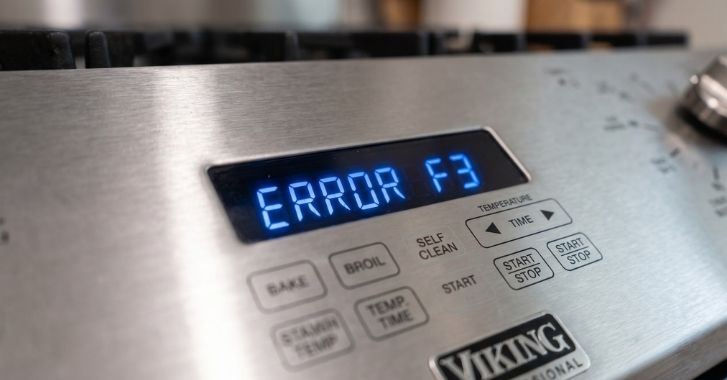
Viking oven and range F-codes flag a fault the control board has detected, most often in the temperature sensor, door lock, or control itself. F1 and F2 usually point to a sensor or door-lock fault, F3 to a controller or sensor-circuit problem, and F10 to an over-temperature condition. Codes vary by model, so always confirm against your unit’s service chart.
An F-code on the display isn’t a breakdown, it’s the oven telling you what it sees. Knowing what the code means helps you decide whether a reset will clear it or a technician is needed. This guide explains the most commonly reported Viking codes, why they appear, and which ones are safe to reset versus call on. Viking Repair Pro services Viking ovens and ranges across California, Colorado, Nevada, Arizona, and Oregon.
How Viking F-codes work
Viking uses an electronic oven control, or EOC, that monitors sensors and shuts down a function when a reading falls outside the safe range. The “F” stands for fault, and the number identifies the circuit involved.
One important caveat drives everything below: Viking has released several EOC generations, so the same code can mean different things across models. Always cross-check your model’s service chart, because the definitions here apply to many Viking ovens but not all.
Common Viking oven and range error codes
The codes below are the most commonly reported across Viking ovens and ranges. Treat them as a starting point, then verify against your unit before ordering any part.
| Code | Commonly indicates | What to do |
| F1 / F01 | Door latch or lock-circuit fault, often after self-clean | Power off 10 min; if it returns, call a technician |
| F2 / F02 | Temperature sensor (RTD/probe) fault or over-temperature | Let the oven cool fully, then restart; persists = service |
| F3 / F03 | Controller fault or open sensor circuit | Technician diagnosis recommended |
| F4 | Shorted temperature sensor | Technician diagnosis recommended |
| F10 | Runaway / over-temperature condition | Unplug 10 min to reset; if it returns, stop using and call |
| F30 / F31 | Sensor (RTD) problem | Technician diagnosis recommended |
| F90 | Door-lock motor or latch error | Technician diagnosis recommended |
Most F-codes trace back to one of three parts: the temperature sensor, the door-lock assembly, or the control board itself. A sensor is an inexpensive part, while a control board is the costliest of the three.
Codes you can safely reset
Some codes clear with a simple power cycle. Switching the oven off at the breaker for 10 minutes lets the control reset, which clears codes triggered by a one-time glitch or a brief over-temperature event.
If the code returns after a reset, the fault is real and needs diagnosis. A code that comes back immediately, especially an over-temperature or door-lock code, means the part has actually failed rather than hiccupped.
Codes that need a technician
Over-temperature and repeated sensor or control faults are not DIY territory. An oven that overheats can be a welded relay holding the heating element on, which is a safety issue, not a nuisance code.
Door-lock codes after a self-clean cycle are also common and usually need the latch assembly or wiring checked. If a control board has failed, that repair is the most expensive of the common oven faults, which is when a repair-or-replace check makes sense. See when to repair or replace a Viking appliance.
When the display itself misbehaves
A flickering or blank display, or random codes, often points to loose connections, moisture, or a failing control board rather than the oven’s heating parts. Power-cycle first, then check that the display isn’t reacting to a recent spill or steam.
If the display stays unreliable, the control board is the likely culprit. Because boards are model-specific, a technician will match the exact part to your unit. You can book through Viking oven repair service or Viking range repair service.
Frequently asked questions
What does F1 mean on a Viking oven?
On most Viking ovens, F1 indicates a door latch or lock-circuit fault, often appearing during or after a self-clean cycle. Try powering the oven off for 10 minutes to clear a one-time glitch. If F1 returns, the latch assembly or its wiring needs a technician, since the code varies by model.
How do I reset a Viking oven error code?
Reset a Viking oven by switching it off at the breaker for about 10 minutes, then restoring power. This clears codes caused by a temporary fault or brief over-temperature event. If the same code reappears after the reset, the underlying part has failed and the oven needs a professional diagnosis.
Are Viking error codes the same on every model?
No. Viking has used several electronic oven control generations, so the same F-code can mean different things across models and software versions. Always confirm a code against your unit’s service chart or rating-plate model number before ordering parts. A certified technician can read the code in the context of your model.
Get the right code read for your Viking
An F-code narrows the problem, but the right fix depends on your exact model and what the control is actually seeing. When a reset doesn’t clear it, a technician who knows Viking’s EOC generations can pinpoint the part the first time. Book a Viking oven or range diagnostic with Viking Repair Pro and get it read correctly.