A Viking freezer not freezing usually has an airflow or defrost problem: dirty coils, a failed evaporator fan, a worn door gasket, or a frosted-over defrost system. A freezer that over-freezes points to a stuck thermostat, a leaking gasket, or a defrost fault. Set it to 0°F, then start with the coils and the door seal.
Soft ice cream and frost-coated walls trace back to the same few systems, just in opposite directions. This guide covers a Viking freezer not freezing, a Viking freezer over-freezing, and how to manually defrost the unit safely. Viking Repair Pro is a Viking-only appliance specialist serving eight markets across Colorado, Nevada, California, Arizona, and Oregon. For other symptoms, see our full Viking refrigerator troubleshooting guide, or keep reading for the freezer.
Set the freezer to 0°F and check the basics
Start with settings and airflow before you suspect a part. A Viking freezer should hold 0°F, and food safety drops off quickly once it drifts warmer than that.
- Temperature: set the freezer to 0°F and give it 24 hours to stabilize.
- Door seal: run the dollar-bill test on the gasket; a leaking seal lets warm, humid air in.
- Airflow: avoid overpacking, which blocks the vents and the evaporator fan.
- Coils: if the condenser coils look dusty, clean them, the top cause of weak cooling.
If the freezer still will not hold 0°F after that, match your symptom below.
Viking freezer not freezing: the usual causes
A Viking that runs but will not freeze points to airflow or the sealed system, in a clear order. Dirty condenser coils are the single most common cause, because dust traps the heat the system is trying to release.
After the coils, check the evaporator fan. Open the door and hold the door switch closed; most Viking models shut the fan off when the door opens, so you need to trick it to hear the fan run. A fan that is silent or iced over cannot circulate cold air.
Heavy frost on the evaporator coil usually means a defrost system fault, where a failed heater, thermostat, or control board lets ice choke airflow. A freezer that is cold while the fridge stays warm is the inverse problem, covered in Viking refrigerator not cooling.
Viking freezer over-freezing or frost buildup
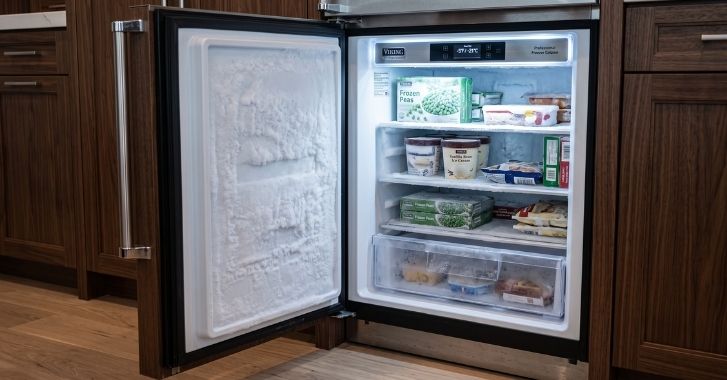
Too-cold and frost-coated are different symptoms with overlapping causes. Frost buildup on the walls or coil almost always signals a defrost fault or a leaking door gasket, not normal operation.
If the freezer runs too cold, suspect a temperature set too low or a stuck thermostat or thermistor that misreads the temperature. If the walls coat with frost, a worn gasket is letting humid air condense and freeze, or the defrost system has failed. On a frost-free Viking, recurring frost is your signal that a defrost component needs attention.
How to manually defrost a Viking freezer
A manual defrost clears choking frost and helps pinpoint a defrost fault. Work gently, and never use a sharp tool on the ice.
- Turn it off. Unplug the freezer or switch off its breaker.
- Empty it. Move food to a cooler with ice packs.
- Let the ice melt. Place bowls of hot water inside and close the door to speed it, replacing the water every hour.
- Do not chip the ice. Lift loosened chunks by hand with gloves; a knife or pick can puncture the coil.
- Dry the interior. Wipe everything down with a towel once the ice is gone.
- Restore power. Plug it back in and let the freezer return to 0°F before reloading.
If the freezer cools normally after a manual defrost but frosts up again within weeks, the defrost timer, heater, or thermostat is the likely fault.
When to call a Viking technician
Some freezer faults are not do-it-yourself jobs. A defrost heater runs about $120 to $400 and an evaporator fan motor $200 to $400, and both involve panel removal and electrical testing.
Call a professional when the defrost system, evaporator fan, or thermostat needs replacement, or when the freezer will not cool at all. A freezer that runs constantly but stays warm, with an incomplete frost pattern on the coil, can signal a refrigerant leak, which requires EPA-certified work. Built-in Viking models are sensitive to disassembly, so leave sealed-system access to a specialist with OEM parts.
Frequently asked questions
What temperature should a Viking freezer be?
A Viking freezer should be set to 0°F for proper freezing and food safety. The fridge section should sit around 37°F. If the freezer drifts warmer than 0°F, start with the condenser coils and the door gasket, then check the evaporator fan and defrost system before assuming a major part has failed.
Why is my Viking freezer building up frost?
Frost buildup on a Viking freezer usually means a worn door gasket or a defrost system fault. A leaking seal lets warm, humid air condense and freeze inside, while a failed defrost heater or thermostat lets ice choke the evaporator coil. On a frost-free model, recurring frost is a sign a defrost component needs service.
Why is my Viking freezer running constantly?
A Viking freezer that runs nonstop is usually fighting poor airflow or lost cold air. The common causes are dirty condenser coils, a worn door gasket, frost on the evaporator coil, or a failing fan. Cleaning the coils and checking the seal often resolves it; if the freezer still runs constantly, have the defrost system and fan tested.
Can I fix a Viking freezer that won’t freeze myself?
You can handle the basics yourself: setting 0°F, checking the door gasket, clearing overpacked vents, cleaning the coils, and running a manual defrost. Those steps solve many cases. Defrost components, the evaporator fan, the thermostat, and any sealed-system or refrigerant work need a certified technician with the right tools.
Get your Viking freezing properly again
A Viking freezer that will not freeze, or one that over-freezes, almost always traces to airflow, the door seal, or the defrost system. The basic checks above solve the common cases and tell you when a part has failed. When the fix points to the defrost system, the fan, or the sealed system, the right move is a diagnosis, not another defrost. Book a Viking freezer repair or contact our certified team for a written diagnosis on your model.