To clean Viking refrigerator condenser coils, unplug the unit, remove the front grille or kickplate, then vacuum and brush the coils with a coil brush. The job takes about 15 minutes and should be done every 6 to 12 months, more often with pets. Clean coils are the cheapest fix for weak cooling.
If your Viking is not cooling like it used to, dirty condenser coils are the first thing to rule out. Dust acts like a blanket over the coils, trapping the heat your fridge is trying to release and forcing the compressor to work harder. This guide shows where the coils sit on a Viking, the tools you need, the exact cleaning steps, and how often to repeat them. Viking Repair Pro is a Viking-only appliance specialist serving eight markets across Colorado, Nevada, California, Arizona, and Oregon. Done twice a year, this one task can extend your Viking’s service life.
Why dirty coils make your Viking stop cooling
The condenser coils release the heat your refrigerant pulls out of the cabinet. When dust and pet hair coat them, that heat has nowhere to go, so the compressor runs longer and the fridge struggles to hold temperature. Cleaning the coils restores efficiency and is the single most common fix for gradual cooling loss.
Left unaddressed, clogged coils raise your energy bill and can lead to compressor overheating. That is why coil cleaning is the first step a technician recommends before testing any part. If your Viking is already warm, pair this with our not-cooling diagnostic checklist.
Where the condenser coils are on a Viking refrigerator
On most built-in and professional Viking refrigerators, the coils sit behind the grille at the front of the unit, top or bottom. Freestanding models usually have them at the bottom front behind a kickplate, or across the back. Front-grille coils are the most common layout on newer fridges.
If you cannot find the coils, check your model’s owner’s manual before prying anything loose. Some grilles snap off by hand, while others are held by a screw or two. Built-in Viking units in tight cabinetry can be awkward to access, so a flashlight helps.
What you’ll need
- A refrigerator coil brush or any long, soft-bristle brush
- A vacuum with a crevice or brush attachment
- Work gloves (the condenser fins have sharp edges)
- A flathead screwdriver, if your grille is screwed in place
- A flashlight for built-in models
How to clean Viking refrigerator condenser coils, step by step
The whole job takes about 15 minutes. Work gently around the fins and never pull on the refrigerant tubing.
- Disconnect the power. Unplug the refrigerator or switch off its breaker before you touch anything.
- Remove the grille or kickplate. Pull off the front grille by hand, or remove the screws on a kickplate. For rear coils, ease the unit away from the wall.
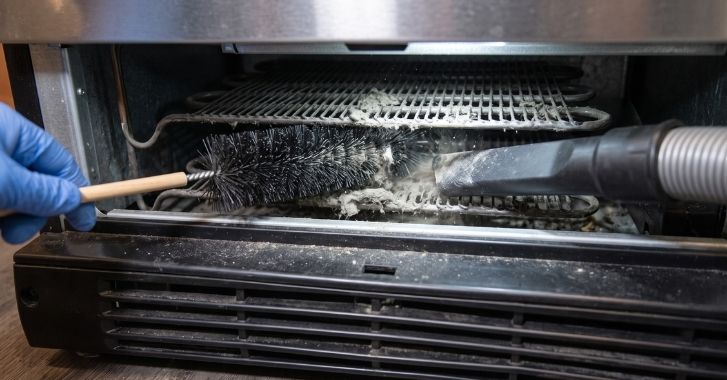
- Vacuum the loose dust. Use the brush attachment to clear the grille opening and the visible dust around the coils.
- Brush the coils. Work the coil brush along the fins to loosen packed dust and pet hair, taking care not to bend the fins or disturb the water line.
- Vacuum again. Pull away everything you dislodged, alternating brushing and vacuuming until the coils look clear.
- Wipe the area (optional). If you can reach the coils, a slightly damp cloth removes stubborn film; let them air dry.
- Replace the grille. Snap or screw the grille back into place and slide the fridge back if you moved it.
- Restore power. Plug the unit back in. A built-in Viking can take up to 24 hours to fully stabilize its temperature.
How often to clean Viking refrigerator coils
Clean the coils every 6 to 12 months in a normal home. Step that up to every 3 to 6 months if you have pets, carpet, or a dusty environment, because hair and dander pack the fins faster.
Built-in Viking models installed in enclosed cabinetry run warmer, so a twice-a-year schedule is the safe default. Put it on the calendar with your water-filter change so the maintenance habits travel together.
When coil cleaning won’t fix the cooling problem
If the fridge is still warm a day after a thorough cleaning, the fault is deeper than dust. The next suspects are the evaporator fan, the temperature sensor, and the sealed system.
Sealed-system and refrigerant work require an EPA-certified technician, so they are never a do-it-yourself fix. When the coils are clean and cooling is still weak, the smart move is a diagnosis. You can book a Viking refrigerator diagnosis rather than keep guessing at parts.
Frequently asked questions
How often should I clean my Viking refrigerator coils?
Clean Viking refrigerator condenser coils every 6 to 12 months in a typical home, or every 3 to 6 months with pets or heavy dust. Dirty coils are the most common cause of weak cooling and higher energy bills. The task takes about 15 minutes with a coil brush and a vacuum and needs no special tools.
Can I clean built-in Viking coils myself, or do I need a pro?
You can usually clean built-in Viking coils yourself, since the coils sit behind a removable front grille. The work is light, but the cabinetry can make access tight. If your unit is boxed into cabinets with no clear grille access, a technician can clean the coils during a maintenance visit safely and quickly.
Do I need a special coil brush?
A dedicated refrigerator coil brush works best, but any long, soft-bristle brush paired with a vacuum will do the job. The brush loosens packed dust deep in the fins that a vacuum alone cannot reach. Avoid stiff wire brushes, which can bend the delicate fins and damage the coils.
Will cleaning the coils fix my Viking that isn’t cooling?
Cleaning the coils fixes a large share of gradual cooling complaints, because dust is the most common cause. If your Viking is still warm 24 hours after a thorough cleaning, the problem is likely the evaporator fan, temperature sensor, or sealed system. Those faults need a professional diagnosis rather than another cleaning.
Keep your Viking cold with a 15-minute habit
Cleaning the condenser coils is the cheapest, easiest way to protect a Viking refrigerator and the food inside it. Twice a year keeps the compressor from overworking and heads off the most common cooling complaint before it starts. If you clean the coils and the fridge still will not hold temperature, that is your signal to call. Book a Viking refrigerator service or contact our certified team for a written diagnosis on your model.