A Viking oven that won’t turn on usually has a power problem, not a broken oven. Start with the breaker, the wall outlet, and the control lock, then power-cycle the unit for five minutes. If the display stays dark after that, the control board or thermal fuse is the likely failure.
Most “dead” Viking ovens trace back to something simple upstream of the appliance. Viking Repair Pro is a Viking appliance repair specialist, and this guide walks the same power-first checks a technician runs before opening a single panel. You will learn how to tell a power fault from a control-board failure, which fixes are safe to try yourself, and when the smart move is to book a Viking oven repair. Work through the steps in order, because skipping the easy ones is how people pay for parts they never needed.
Start here: is it a power problem or the oven?
Before you touch a tool, decide which of three states your oven is in. That single observation points you at the right fix and saves an hour of guessing. Roughly 8 in 10 “won’t turn on” calls resolve at the power source or the control panel, not deep inside the oven.
- Completely dark — no display, no lights, no fan. This points to lost power: a breaker, an outlet, or the oven’s power supply.
- Display on, oven won’t respond — the clock or panel lights up, but buttons do nothing. This points to control lock, a stuck self-clean cycle, or a failing control board.
- Powers on, then shuts off — the oven lights up and dies within seconds. This points to a wiring fault or a protective component like a thermal fuse.
Note which one you have. You will use it at every step below.
Why won’t my oven turn on but the cooktop or stove still works?
On a Viking range, the gas burners run on a gas supply and a spark igniter, so they light even when the oven’s electronics are dead. The oven’s control board, display, and igniter still need 120V from the electrical circuit. A working cooktop with a dark oven almost always means the oven lost its electrical feed, not its gas.
Step-by-step: what to check before you call
Run these in order. Each one rules out a common cause, and the first three fix the majority of no-power complaints. Stop as soon as the oven responds.
Step 1 — Check the breaker. Open your electrical panel and find the oven or range breaker. If it sits between on and off, flip it fully off, wait ten seconds, then firmly back on. A tripped breaker is the single most common reason a Viking oven goes dark.
Step 2 — Confirm the outlet has power. Freestanding ranges plug into a 240V outlet behind the unit. Some Viking models sit on a shared circuit or a GFCI that can trip. If a nearby GFCI outlet is tripped, reset it and re-test the oven.
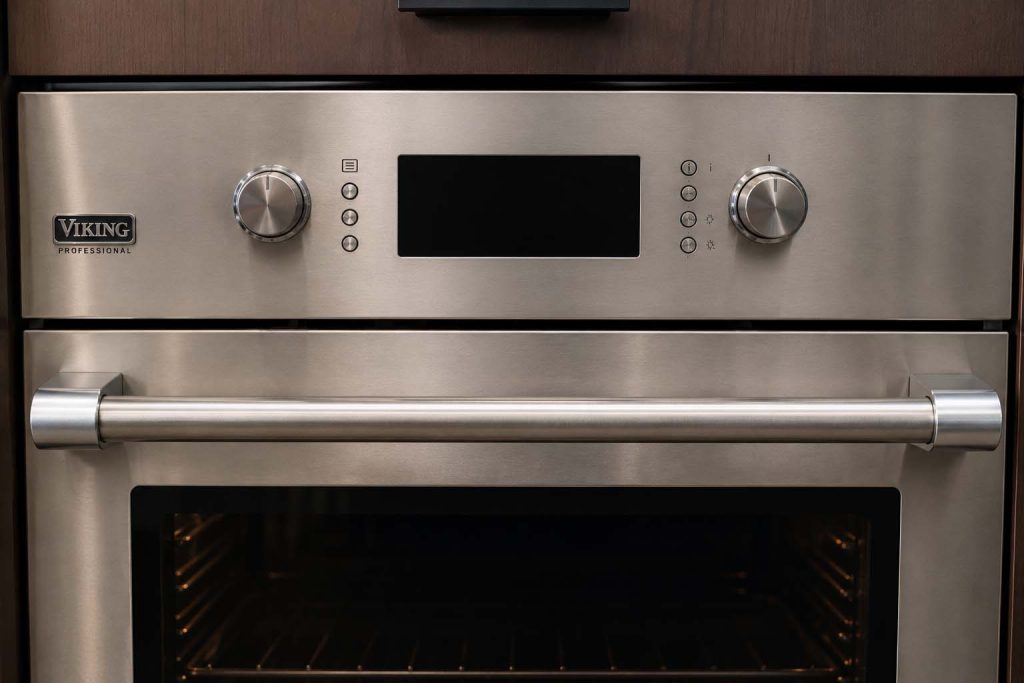
Step 3 — Release the control lock. A lit display with dead buttons is often just the control-lock feature. On most Viking panels, press and hold the lock or key symbol for about three seconds until the lock indicator clears. This is a settings state, not a fault.
Step 4 — Check for a stuck self-clean lock. If the oven ran a self-clean cycle, the door may still be latched and the controls disabled until it fully cools. Give it up to 90 minutes to release. A latch stuck after cooling needs a technician.
Step 5 — Power-cycle the oven. Turn the breaker off for five full minutes, then back on. This clears a locked-up control board the same way restarting a frozen computer does. It is the last safe do-it-yourself reset.
How do I reset a Viking oven?
To reset a Viking oven, switch off its dedicated breaker at the electrical panel, wait five minutes, then switch it back on. This full power-cycle clears a hung control board and restores a frozen or unresponsive display. If the oven stays dark after the reset, the problem is a hardware fault, not a glitch.
Safety first: gas and 240-volt hazards
A Viking oven runs on either a 240V circuit or a gas line, and both can injure you. Treat every check as if the power is live until you have physically switched off the breaker.
If you smell gas, stop. Do not flip switches, unplug anything, or use your phone in the room. Leave the home, then call your gas utility and a licensed technician from outside.
Before removing any panel, kill the power. Switch off the oven’s breaker, not just the controls. Behind the back panel sits 240V wiring that can be fatal, so this is where do-it-yourself checks end for most homeowners. Never bypass or “jump” a thermal fuse to force the oven on, because that fuse is a fire-safety device.
When it’s the control board or thermal fuse
If power is confirmed and a reset did nothing, the fault is inside the oven. Two parts account for most no-power failures on Viking ovens: the electronic control board and the thermal fuse. Diagnosing either one correctly requires a multimeter and the model’s wiring diagram.
Electronic control board (ERC). This board runs the display, relays, and heating commands. A dead or partly lit display, unresponsive buttons after a reset, or an oven that powers on then quits often points here. A failed relay on the board can cut power to the whole oven.
Thermal fuse or thermal cutoff. This one-time safety device opens when the oven overheats, usually after a self-clean cycle, and stays open permanently. When it blows, the oven can go completely dark. It must be replaced, never bridged, and the reason it tripped should be checked too.
Power supply and wiring. Burned connectors at the terminal block or a damaged harness can starve the board of voltage. These are technician-level diagnoses because they involve live 240V testing.
A written diagnosis pinpoints which part failed before any money is spent on components, which is how you avoid the common “replaced the board, still dead” trap. A Viking oven that won’t heat after it does power on is a different problem covered in our guide to a Viking oven not heating, and a gas oven that lights the cooktop but not the bake burner points to the gas range that won’t light.
Repair cost and when to call a Viking pro
Fixing a Viking oven that won’t turn on is almost always worth it, because the failed part is cheap relative to the appliance. A replacement Viking range runs several thousand dollars, so a control-board or fuse repair protects a far larger investment.
Typical national repair ranges for these faults look like this. Treat them as planning estimates; your written quote is the number that counts.
| Fault | Typical repair range (parts + labor) | Usual visit |
| Tripped breaker / control lock / reset | $0 (do-it-yourself) to a diagnostic fee | Same visit |
| Thermal fuse replacement | $150 to $300 | One visit |
| Electronic control board (ERC) | $300 to $650 | One visit, part permitting |
| Wiring / terminal-block repair | $200 to $450 | One visit |
Call a professional when: the display stays dark after a reset, a breaker trips again immediately, the self-clean latch won’t release, you see or smell burning, or the fix requires opening a panel. Anything behind the back panel means live 240V and OEM parts matched to your model. A specialist arrives with the wiring diagram and the right board, so most no-power repairs finish in a single visit. When you are ready, schedule a Viking oven repair and describe which of the three power states your oven is in.
Frequently asked questions
Why is my Viking oven display dark but the stove still works?
A dark oven display with a working stove means the oven lost its electrical feed while the gas burners kept their supply. The oven’s board and igniter need 120V, so check the oven’s breaker, its outlet, and any shared GFCI first. The gas cooktop lighting normally does not confirm the oven has power.
Can a bad thermal fuse stop a Viking oven from turning on?
Yes. A blown thermal fuse can cut power to the oven and leave the display completely dark. The fuse opens permanently when it senses overheating, most often after a self-clean cycle, and it must be replaced rather than reset. A technician also checks why it tripped, so the new fuse does not blow again.
How much does it cost to fix a Viking oven that won’t turn on?
Many no-power issues cost nothing beyond a reset or a breaker flip. When a part has failed, a thermal fuse typically runs $150 to $300 and a control board $300 to $650, parts and labor included. A written diagnosis confirms the exact part before you approve any spend.
Is it worth repairing a Viking oven that won’t power on?
In almost every case, yes. A control board or fuse repair costs a few hundred dollars against a Viking range worth several thousand, so the repair-versus-replace math strongly favors fixing it. Replacement only makes sense if the oven has multiple failing systems or is decades old.
Why does my Viking oven turn on then shut off right away?
An oven that powers on and dies within seconds usually has a wiring fault, a failing relay on the control board, or a protective component cutting the circuit. This is not a do-it-yourself fix because it involves live 240V testing. Switch the oven off at the breaker and book a technician to trace the fault safely.
The bottom line
A Viking oven that won’t turn on is far more often a power or control-panel issue than a dead appliance. Work the checks in order: breaker, outlet, control lock, self-clean latch, then a five-minute power-cycle. If the display is still dark, the control board or thermal fuse is the likely cause, and those need a multimeter and OEM parts to fix safely. Note which of the three power states your oven is in and schedule a Viking oven repair so a specialist arrives with the right part for a single-visit fix.