A Viking oven that won’t heat most often has a failed hot-surface igniter on gas models or a burned-out bake element on electric models. Other causes include a tripped breaker, a blown thermal fuse, a drifted temperature sensor, or a failed control relay board. Igniter and element swaps are usually single-visit repairs.
The fix depends on which fuel your oven uses, so this guide splits the diagnosis into gas and electric paths. You’ll check the simple stuff first, then work through the igniter, bake element, temperature sensor, and control board in the order a technician would. Viking Repair Pro services Viking ranges, wall ovens, and cooktops nationwide with factory-trained, Viking-certified technicians and genuine Viking parts. If you’d rather not run the tests yourself, you can book Viking oven repair and have a tech pinpoint the fault in one visit.
Check these five things before blaming a part
Start with the checks that cost nothing. A surprising share of “dead oven” calls end at the breaker panel or the control settings, not inside the appliance.
- The breaker. Viking wall ovens and electric ranges run on a double 240-volt breaker. A half-tripped double breaker can kill the heat while the display stays lit, so switch it fully off, wait a minute, and reset it.
- The gas supply. If the range moved recently or other gas appliances are acting up, confirm the shutoff valve behind the range is fully open.
- The mode and clock. Make sure the oven is set to Bake, not just the timer, and that any Sabbath or showroom mode is off.
- The door lock. A door latch stuck from a self-clean cycle blocks heating on many models. Let the oven cool fully and check that the latch has released.
- The selector knobs. On mechanical-control Viking ranges, a selector knob that sits between detents can leave the thermostat calling for nothing.
If everything checks out and the cavity stays cold, the fault is in a component. Which one depends on your fuel type — and on dual-fuel VDR-series ranges, remember the oven itself is electric even though the burners run on gas.
Gas Viking oven not heating: start with the igniter
The hot-surface igniter is the most common failure behind a gas oven not heating. It works as both lighter and gatekeeper: the igniter must glow hot and draw enough current before the oven safety valve will open and release gas. A healthy igniter opens the safety valve within about 60 seconds; a weak one can glow orange all day without ever lighting the burner.
That failure mode fools a lot of owners. The igniter looks alive — it glows — but it never gets hot enough to trip the valve, so no gas flows and the oven never fires. Weak igniters also cause slow preheating and ovens that light on some days but not others.
How do I know if my Viking oven igniter is bad?
Set the oven to Bake and watch the burner at the base of the cavity through the first two minutes. You’ll see one of three patterns:
- Glows but never lights: the igniter is weak and no longer draws enough current to open the safety valve. Replace it.
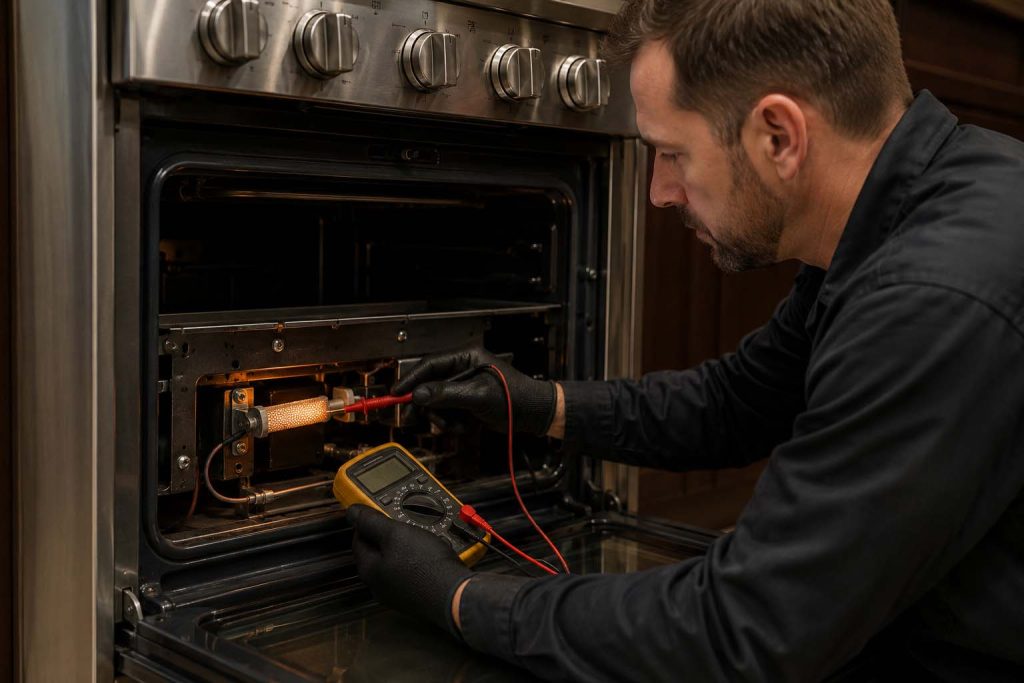
- No glow at all: the igniter is cracked or open, or power isn’t reaching it. A technician confirms which with a continuity test.
- Glows, lights, then the flame drops out mid-bake: a failing igniter or safety valve cutting out under heat.
If the igniter tests healthy and still no flame appears, the oven safety valve itself is the next suspect. Valve faults are far less common than igniter faults, which is why techs always test the igniter first.
Safety first: if you smell gas at any point, stop the diagnosis, shut off the oven, and ventilate the kitchen. Follow the steps in our Viking gas smell safety guide before doing anything else.
Why does the stovetop work but the oven won’t heat?
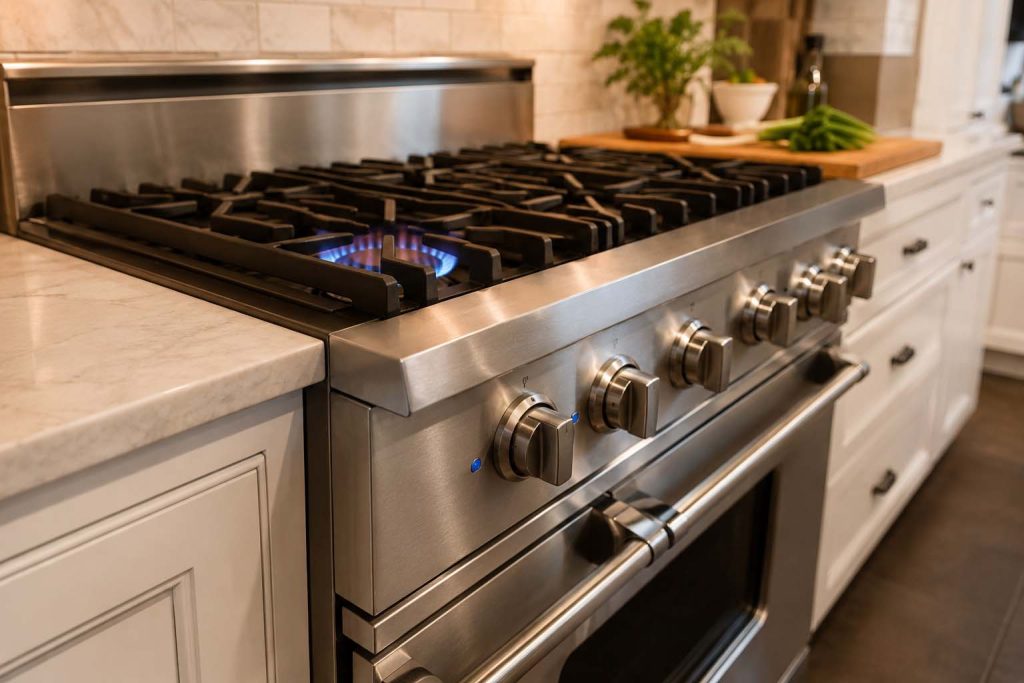
Working burners with a cold oven means the gas supply is fine — the two systems just ignite differently. Viking surface burners use spark electrodes, while the oven uses a hot-surface igniter and safety valve. One system can fail while the other works perfectly. So a dead oven under live burners points at the oven igniter, and the reverse problem — surface burners that won’t light — points at the spark module or electrodes instead.
Electric Viking oven not heating: element and power checks
On electric and dual-fuel Viking ovens, the bake element does the work the gas burner does on gas models — and it fails more visibly. Turn on Bake for a few minutes, then look: a healthy element glows evenly red, while a failed one shows a blister, a bubbled spot, or a clean break. A damaged element is a straightforward one-visit replacement.
If the element looks intact but stays cold, check the power before condemning parts. Electric ovens need both legs of a 240-volt circuit to heat; with one leg lost, the display and lights still run on 120 volts while the elements stay stone cold. A half-tripped double breaker or a worn wall connection causes exactly this pattern, and it’s a fault owners almost never suspect because the oven “looks on.”
Two more electric-side suspects: the broil element, if broiling is the mode that fails, and the relay that switches power to the elements. Relay faults live on the control board and need a technician’s diagnosis — replacing elements around a bad relay wastes money.
Oven temperature not accurate? Test the sensor and calibration
An oven that heats but bakes unevenly or runs cold has a different fault path than one that’s fully dead. First confirm the problem with a standalone oven thermometer: set 350°F, let the oven cycle for 20 minutes, and take three readings a few minutes apart. Ovens normally swing 25–30 degrees around the set point as the thermostat cycles, so judge the average, not a single reading.
If the average is off by more than about 25 degrees, suspect the temperature sensor — the thin probe at the top rear corner of the cavity. Most oven sensors read close to 1,080–1,100 ohms at room temperature; readings far outside that range mean the sensor has drifted and should be replaced. A drifted sensor tells the control board the wrong temperature, so the board cuts heat too early or too late every single bake.
If the sensor tests fine and the offset is modest and consistent, calibration is the fix. Most electronic-control Viking ovens allow a user calibration offset of roughly ±35°F from the control panel; the exact button sequence varies by model, so check your model’s use-and-care manual. Also confirm the sensor probe isn’t touching the cavity wall and that bent racks or foil liners aren’t blocking airflow — both skew real-world results without any part being bad.
Control board, thermostat, and thermal fuse faults
When the igniter, element, sensor, and power supply all test healthy, the remaining suspects are the control side. On electronic-control models, the board’s relays switch every heating circuit, and a stuck or burned relay produces no heat, nonstop heat, or heat in one mode only. On older mechanical-thermostat ranges, the thermostat itself can fail cold.
The thermal fuse deserves special mention. Self-clean cycles push cavity temperatures to roughly 850°F, and that heat spike is the classic trigger for a blown thermal fuse — which is why so many ovens die the day after a self-clean. The fuse is a safety device: it must be replaced, not bypassed, and a tech should confirm why it blew.
If your display is showing a fault code along with the no-heat symptom, decode it before anyone orders parts. Our Viking oven and range error code guide lists what each code means and which component it implicates. Board-level faults are firmly professional territory on a Viking — misdiagnosed boards are among the most expensive guesswork mistakes owners make.
Repair costs and when to call a pro
Confident DIYers can handle the zero-cost checks and a visible bake-element swap on an unplugged oven. Everything involving gas components, 240-volt testing, thermal fuses, or control boards belongs with a technician — the diagnosis requires live-circuit measurements, and gas work carries real safety stakes.
The good news: no-heat faults sit at the affordable end of Viking repair. Based on the figures in our Viking range, stove & cooktop repair cost guide, an igniter replacement typically runs $150–$300, heating elements $150–$450, temperature sensors $100–$350, and control boards $200–$600. Every one of those numbers is small against a Viking range or wall oven that cost $5,000–$20,000 new, which is why repairing a no-heat fault is almost always the right call on this brand.
Viking Repair Pro technicians are factory trained and Viking certified, install genuine Viking parts, and back the work with a warranty on parts and labor. Same-day and next-day appointments are available in most service areas. A tech arrives with the common failure parts for VEDO, VESO, VDOE, and VSOE wall ovens and Viking range series, so most no-heat repairs finish in a single visit.
Frequently asked questions
How do I reset my Viking oven?
Reset a Viking oven by switching its circuit breaker off, waiting about one minute, and switching it back on. This reboots the electronic control and clears many one-off glitches after power surges or outages. If the oven still won’t heat after a reset, the fault is in a component — the igniter, element, sensor, or board — not the software.
Why won’t my Viking oven heat after a self-clean cycle?
An oven that dies right after self-cleaning has usually blown its thermal fuse or jammed its door latch. Self-clean temperatures near 850°F stress both parts more than any normal bake. Let the oven cool completely and check that the door latch released; if the oven still won’t heat, have a technician replace the thermal fuse and verify nothing else overheated.
How do I fix a Viking oven temperature that’s not accurate?
Fix inaccurate oven temperature by testing with a standalone thermometer, then either recalibrating or replacing the sensor. If the average error is modest and consistent, adjust the calibration offset — most electronic Viking controls allow roughly ±35°F. If the error is large, erratic, or growing, the temperature sensor has drifted and should be replaced.
What is the average lifespan of a Viking gas oven?
A Viking gas range or oven typically serves 15–20 years or more with maintenance, which is why heating repairs are usually worth making. Wear parts fail sooner: igniters and door gaskets often need replacement during the appliance’s life. See our guide to how long Viking appliances last for lifespan benchmarks by appliance type.
Is it worth repairing a Viking oven that won’t heat?
Yes — repairing a Viking oven that won’t heat is almost always worth it. The common fixes (igniter, element, sensor) run in the low hundreds, while replacing a Viking range or wall oven costs thousands. Unless the oven has multiple failing systems and heavy cavity damage, repair wins the cost math on this brand by a wide margin.
Get your Viking oven heating again
Work the list in order — breaker and settings, then igniter or element, then sensor and calibration, then the control side — and you’ll either find the fault or narrow it to one or two parts. If you’ve reached the gas components or the board, hand it off. Book a diagnosis with a factory-trained Viking technician through our Viking oven repair service, or book a service online and get a confirmed appointment — most no-heat faults are fixed in a single visit with genuine Viking parts.